
Underdog Predict
- Welcome Bonus Keep Your Million (theoretical $1M pot) + 50% deposit match up to $1,000
- Markets Sports only
- Payments ACH, debit, Apple Pay, Venmo
- Sell Positions Early? Yes
 PlayNetwork
Independent US gambling guides · state by state
You're on PlayCA
PlayNetwork
Independent US gambling guides · state by state
You're on PlayCA
Jump To Your State



Underdog Predict lands at 4.2 out of 5 for the same reason it would anywhere else: fast banking and honest fills carry it, while a single-category focus and some real gaps between its terms and its practice hold it back. For a California trader, there’s an extra wrinkle worth knowing upfront. This state has no legal regulated sports betting, but Underdog Predict isn’t sports betting. It’s a federally regulated prediction app, and that distinction is worth understanding before you fund an account.
Promo code PMPLAYCA unlocks “Keep Your Million,” a free-to-play survival game, alongside a 50% first-deposit match up to $1,000 where it’s offered. The catch: Underdog’s own terms block bonus funds from Predict trades entirely, yet testing and a direct answer from support confirmed they work anyway, on entries paying 2x or better.
Banking is this platform’s clear strength — fast deposits, a 24-hour withdrawal, and a payout that cleared in under 30 minutes after a game ended. Market coverage is the obvious ceiling: Underdog never strays outside sports, which matters if you’re the kind of California trader who’d rather trade on the next Fed rate call than the Lakers’ next back-to-back.

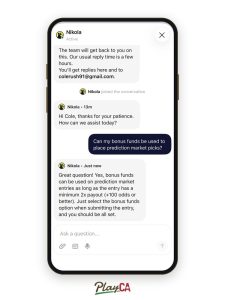
The terms page and the support chat told two different stories.
Underdog’s fine print blocks bonus funds from Predict trades outright, but a support agent confirmed otherwise, specifically, once a pick cleared 2x.
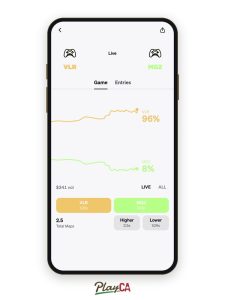
A settlement source named itself the referee.
Of 16 sampled markets, a World Chess Championship contract listed “Underdog Predict” as its own settlement source — one of the inputs behind the Market Coverage number.
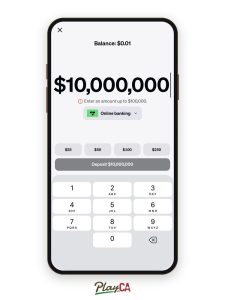
A seven-figure deposit test found the real ceiling.
An intentional $10,000,000 deposit attempt bounced at the actual $100,000 cap, far past what the app’s own quick-pick buttons imply.
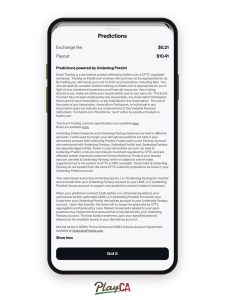
The order ticket told the truth the help center didn’t.
A UDX-powered trade carried a $0.91 fee and a Kalshi-powered one carried $0.21, both disclosed before confirmation — above the help center’s quoted rate.
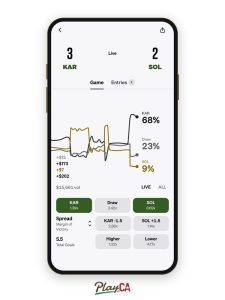
A crowded market and a quiet one priced the same way.
Round-trip cost came to 3.3% on the busy side, 5.2% on the quiet side, both filled exactly at the quoted price.
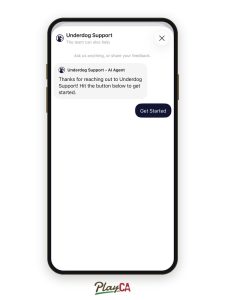
Support needed a human to actually answer the question.
A chatbot looped on a nuanced question; a person joined the same thread minutes later with a specific, usable answer.
“Keep Your Million” is Underdog’s free-to-play headline offer: a theoretical $1 million pot, split across up to 20 questions, with whatever survives converting to real bonus funds. Where it’s offered, a 50% first-deposit match up to $1,000 rides alongside it — $10 minimum deposit, $2,000 to max out the match.
| Field | Detail |
| Welcome Offer | “Keep Your Million” — free-to-play, up to $1,000,000 in theoretical bonus funds |
| First-Deposit Match | 50% up to $1,000 ($10 minimum deposit; $2,000 to max out) |
| Playthrough Requirement | 1x within 14 days |
| Bonus Funds Usable on Predict? | Underdog’s terms say no; testing and a support agent confirmed yes, on entries at 2x payout (+100 odds) or better |
Pick a question tied to an upcoming game, split the pot between the two outcomes with a slider, and lock it in before kickoff. Whatever lands on the winning side carries into the next question. Clear all 20 and the survivors convert to real bonus funds; bust out early and the run just ends.
Underdog leans into a single big, gamified headline number. Kalshi’s welcome offer runs smaller and more milestone-based — a flat trading credit unlocked once you clear a set trading volume. For a California trader deciding between the two, Underdog’s version is the louder, more immediate offer; Kalshi’s rewards someone who already plans to trade a real volume early.
Six ongoing offers were live during testing: a $10 Bonus Entry, a 40% league boost capped at $50, streak boosts, and a $250,000 Jackpot promo. The Bonus Entry lifted a four-pick slip’s potential payout from $10 to roughly $70.90 in testing, and the league boost pushed a three-pick multiplier from 4.87x to 6.41x. A referral program adds up to $2,000 per friend — $10 per qualifying signup and entry, confirmed via Underdog’s own help center, plus a roughly 1-in-1,000 shot at the full amount.

A deep promotional slate undercut by real confusion over what applies to Predict versus Underdog’s older DFS product, plus a welcome bonus whose own terms technically exclude the trades it’s advertised on.
Underdog Predict trades sports, full stop — no politics, economics, culture, climate, or crypto markets anywhere on the platform. That’s a real difference from broader exchanges like Kalshi, and it’s worth knowing before you sign up expecting the full prediction-markets menu.
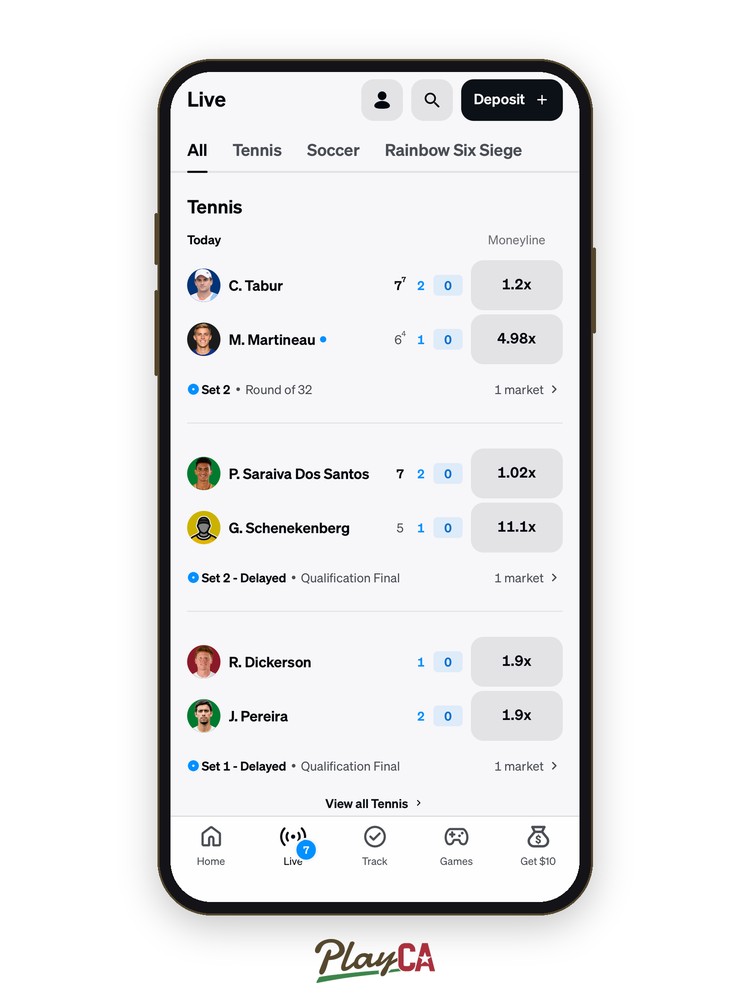
| League | Live Markets |
| NFL | 700+ |
| NCAA Football | 600+ |
| WNBA | 500+ |
| MLB | 500+ |
| NHL | 500+ |
| Esports | 150+ |
| Tennis | 100+ |
| MMA/UFC | 100+ |
| NCAA Basketball | 80+ (off-season futures) |
| Soccer | 35+ |
| CFL | 30+ |
| NBA | 10+ |
| Motorsports | 10+ |
| Cricket | 10 |
| Chess | 9 |
| Golf | 4 |
| Boxing | 3 |
Fifteen of those leagues top a five-market minimum — the line between real coverage and a league that’s just listed for show. For a California trader, that means real depth on the Lakers, Warriors, Kings, 49ers, Rams, Chargers, Dodgers, Giants, Padres, and every other NFL/NBA/MLB market — just nothing beyond sports if you were hoping to trade the next CPI print or a ballot measure.
Picture a market like “Will the Lakers cover the spread against the Warriors tonight?” Every contract trades between $0.01 and $0.99, and that price doubles as the market’s own probability read — a contract sitting at $0.70 implies roughly 70% odds. It’s a hypothetical here, not a market actually tested, but it’s exactly how every real event contract on the platform behaves.
Each market discloses its settling exchange up front — UDX, Kalshi, or Crypto.com|Nadex — with that exchange’s own rulebook deciding the outcome. In testing, only 1 of 2 sampled markets passed every independence test; the chess market mentioned above named itself as the settlement source, which sits oddly next to Underdog’s own claim that it never determines outcomes.
Real depth inside a single category, with one disclosure gap worth knowing about — and for California traders specifically, a hard ceiling the moment your interest wanders past sports.
Funding runs through ACH, debit card, or a digital wallet — Apple Pay, Venmo, and Trustly are all named on the help center. A credit card gets money in fine, but it can’t take money back out; every payout routes to debit instead.
| Method | Deposit? | Withdraw? | Speed (tested) |
| ACH/bank transfer | Yes | Yes | Up to 72 hours (untested) |
| Debit/credit card | Yes | Debit only | Up to 48 hours (untested) |
| Digital wallet | Yes | Yes | 24 hours (tested) |
Both ends of the ledger start at $10, and the real ceiling — $100,000 — only surfaced because testing pushed an intentional deposit well past it. No platform fee applies in either direction; the only real cost is the exchange fee sitting on the order ticket itself, $0.91 on a UDX-powered trade and $0.21 on a Kalshi-powered one.
Whether you’re funding an account from the Bay Area or Southern California, the rails are the same: a $10 Venmo withdrawal cleared in 24 hours during testing, and winnings from a settled WNBA game landed in the withdrawable balance in under 30 minutes. One real discrepancy stood out — Underdog’s terms exclude Venmo from funding Predict trades, yet a Venmo deposit funded a trade seconds after landing, with no block anywhere in the flow.
Fast, fee-transparent, and reliable across every method tested, held back only by a $10 minimum that sits oddly high next to trades that go as low as $1.
Underdog quotes a single price the moment you act, rather than showing a visible order book — so the real test is whether that quoted price holds once real money moves. Here’s what a $10 position looked like on each end of the activity spectrum:
| Market | 24h Volume | Exit Price | Round-Trip Cost |
| Karlbergs BK vs. Sollentuna FF (soccer) | ~$16,000 | $9.66, after 10 min | 3.3% |
| Valerion to win (esports) | ~$350 | $9.47, after 3 min | 5.2% |
Neither trade slipped from the quoted number, and the Yes/No sides added up to roughly 100% on both markets — with no sign of a market-maker program propping up either side.
Costs that are real but predictable, holding steady whether the market was packed or nearly empty — a genuine strength for a platform without visible order-book depth to check against.
Support comes down to two real options: live chat, in-app or on the web, and email at [email protected] — neither one posts set hours anywhere.
| Question | Result |
| A promo/bonus term | Correct and specific |
| A payout/withdrawal rule | Correct |
| A state eligibility detail | Correct |
| A Responsible Trading question | Vague, redirected to in-app tools |
| The dispute-process question | Correct, confirmed no dedicated process exists |
The first reply came from a bot, and it handled the easy stuff fine — until the bonus-eligibility question came up, where it just repeated itself. Asking for a human got a specific, confident answer inside 15 minutes. Email was the slower path by far: a full 13 hours before a separate question got a reply.
Support here follows a familiar pattern: automated and fine for simple questions, unhelpful the moment anything needs nuance. What saves the category is the human escalation — 15 minutes is a reasonable wait, and the answer was specific enough to act on, not a copy-paste dodge.
The chatbot drags the average down, but the human who takes over doesn’t — a 15-minute wait for a real, usable answer is a fair trade for the accuracy you get once you reach one.
Everything runs through one app, Underdog Sports — 4.8 stars on the App Store from roughly 322,000 ratings, 4.6 stars on Google Play from about 33,900 reviews.
| Responsible Trading Tool | Present? |
| Deposit/funding limit | Yes, daily, weekly or monthly |
| Loss or exposure limit | No |
| Session/elapsed-time reminder | No |
| Cool-off/trading break | Yes, 3 days to 9 months |
| Self-exclusion | Yes, 1, 3, 5 or 10 years, or lifetime |
| Education/crisis-line signposting | Yes, 1-800-MY-RESET and NCPG |
| Age verification | Yes, 18+, enforced at signup |
No crashes or load delays turned up on either platform across an entire testing window, but mobile is clearly the intended primary experience — geolocation resolves faster there, and the desktop site keeps nudging toward the app with a QR code. For a trader checking a line between innings at a Dodgers game, that mobile-first design is exactly the point.
Money tied up in an open position never gets mixed in with what’s actually withdrawable — the balance screen keeps withdrawable, non-withdrawable, and bonus funds in clearly separate buckets. Closing the account down, though, means contacting support directly — there’s no self-service toggle for it.
Five of seven canonical responsible-trading tools are present and functional — missing only a loss/exposure limit and a session-time reminder, both tools that intervene mid-session rather than at setup. Two extras go past the standard checklist, too: Regen, which quietly diverts a share of wins and losses into savings, and a treatment-access tie-in with Birches Health.
California is an unusual market for prediction apps specifically. Voters rejected regulated sports betting twice at the ballot box in 2022, and the state still has no legal online sportsbook of any kind. So it’s a fair question: how does an app like Underdog Predict operate here at all?
It’s not sports betting, and that distinction is the whole answer. Prediction apps don’t operate under state gambling law the way a sportsbook would. They run under federal commodities law instead. Underdog Predict’s actual broker of record, UDM, LLC, is registered with the CFTC as a Futures Commission Merchant and NFA member (NFA ID 0570265, verified directly against the NFA’s own BASIC database), and its contracts clear through exchanges like Aristotle Exchange (UDX) and KalshiEX LLC. That federal registration is the real legal basis for operating in California, not a state gambling license, and it’s the same distinction Underdog itself has argued in court against states trying to block it on other grounds.
Practically, that means California traders can open an account, fund it, and trade the same sports-only event contracts covered throughout this review. The rules are the same ones that apply in every other eligible state: 18 or older, plus a one-time questionnaire on employment, income, and trading background before the first trade clears. Nothing about California specifically restricts Underdog Predict beyond those standard rules. It’s worth confirming current status in the app before depositing, though, since this is a genuinely fast-moving regulatory space.
CFTC segregation covers Predict funds, but it’s not a permanent status. Anything that moves into the Fantasy balance loses that protection the moment it lands there. Underdog’s Legal Center doesn’t mention SIPC or FDIC coverage at all, which answers the question of whether either applies. Separately, two real, ongoing stories are worth watching: Underdog’s pending acquisition by IG Group (announced July 30, 2026, roughly $1.3 billion, still awaiting regulatory clearance) and an August 2026 Aristotle Exchange lawsuit over the terms of that deal. Neither is specific to California, but both could shape how the platform operates here down the line.
Underdog Predict
Kalshi (review)

OG (review)
Kalshi and OG figures are confirmed on PlayCA’s own live comparison table for this operator. A third platform, FanDuel Predicts, is mentioned on the live page as a notable new entrant in the California market but isn’t included here with full data — its promotions and liquidity aren’t proven yet, per PlayCA’s own existing coverage, so nothing here is guessed at. See also PlayCA’s own prediction markets hub for the complete ranked list — preserved from the current live page.
FanDuel Predicts is the name California traders are most likely to hear next. It’s not yet a fully proven product the way Underdog, Kalshi, and OG are, but FanDuel’s existing sportsbook user base makes it worth watching if it does launch fully in the state.
The overall 4.2/5 reflects a platform that nails the fundamentals — fast banking, honest fills, support that gets there eventually — while losing ground on real breadth beyond sports and terms that don't always match practice. For a California sports fan who already lives in the Underdog ecosystem, that's an easy recommendation. Traders comparing platforms from scratch should put Kalshi on the list too, especially if California's lack of a regulated sportsbook has you looking for a broader way to trade on more than just the next Warriors game.
Yes. It isn’t sports betting, so it doesn’t need a state gambling license — it operates under federal CFTC registration through its broker, UDM, LLC, which is why it can run in a state with no legal regulated sportsbook. See the dedicated section above for the full explanation.
It checks out — UDM, LLC holds the actual broker registration, a CFTC-licensed Futures Commission Merchant and NFA member, confirmed directly against the NFA’s own BASIC lookup, and customer funds sit in CFTC-segregated accounts.
Check the order ticket, not the help center’s quoted rate — it showed $0.91 on a UDX-powered trade and $0.21 on a Kalshi-powered one during testing, both disclosed before confirmation.
Fast, in testing — a Venmo withdrawal cleared inside 24 hours, and a payout from a finished game landed in the account in well under half an hour.
Yes — PMPLAYCA unlocks “Keep Your Million” and, where offered, a 50% first-deposit match up to $1,000.
No — the platform offers no margin or credit-funded positions, confirmed in testing and absent from its Legal Center, so losses are limited to funds actually in play.